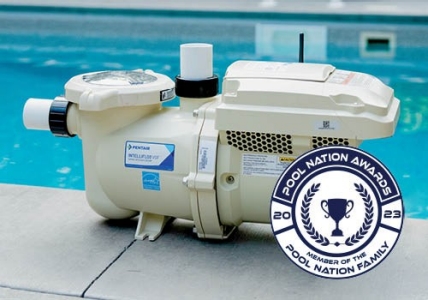
pool service company


Last updated: March 17, 2026
Quick Answer: A pool service company in Corona handles everything from weekly chemical balancing and equipment checks to full repairs and seasonal maintenance. Hiring a professional keeps your pool safe, extends equipment life, and saves you from costly emergency fixes. In Corona’s hot inland climate, consistent service is not optional — it’s essential.
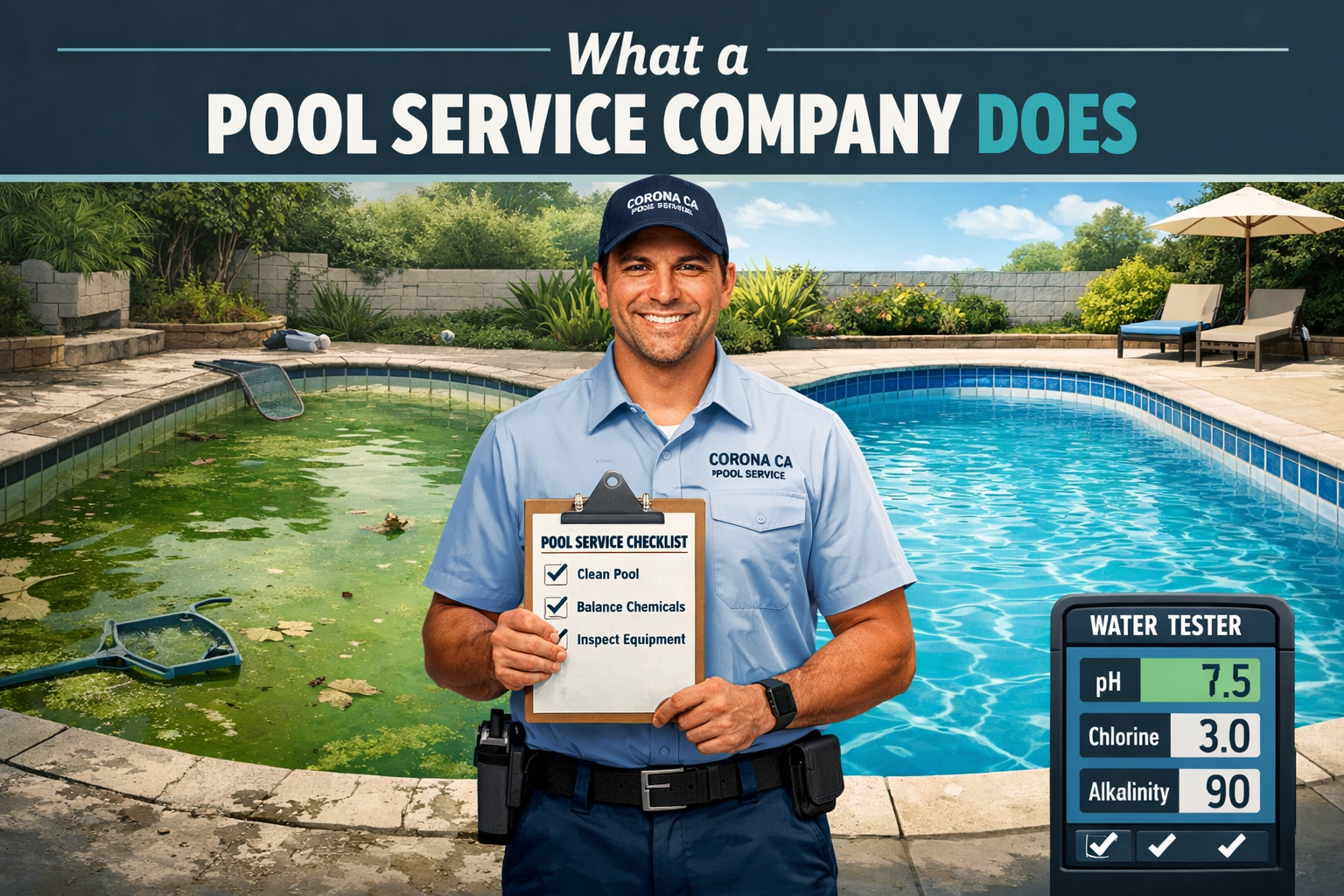
A professional pool service company handles the full range of tasks that keep your pool clean, chemically balanced, and mechanically sound. For Corona homeowners, this typically means weekly visits that cover water testing, chemical adjustment, skimming, brushing, vacuuming, and equipment inspection.
Here’s what a standard weekly service visit includes:
Beyond weekly maintenance, a full-service pool company also handles equipment repairs for pumps, filters, and heaters, algae treatments, and pool renovations.
Corona’s climate is one of the most demanding for pool owners in Southern California. Summer temperatures regularly exceed 100°F, and that heat does two things: it accelerates algae growth and burns off chlorine faster than in cooler climates. A pool that looks fine on Monday can turn green by Friday without proper chemical management.
Choose professional service if:
You might skip weekly service if:
For most Corona homeowners, the math favors professional service. A single algae treatment or equipment repair can cost more than several months of maintenance fees. Consistent service from a trusted pool service company in Corona prevents those emergencies.
💡 “Prevention is always cheaper than correction.” That’s especially true with pool chemistry — catching an imbalance early costs a few dollars in chemicals. Ignoring it can cost hundreds in algae treatment or surface damage.
The best pool service company for your home is licensed, insured, communicative, and consistent. Here’s how to evaluate your options before signing anything.
In California, pool service technicians who apply pesticides (including algaecides) are required to hold a Qualified Applicator Certificate or work under a licensed applicator. Always ask for proof of:
This one matters more than most homeowners realize. According to 2026 industry data, 45% of pool service companies include chemicals in their monthly pricing, 30% bill separately, and 25% use a hybrid model [2]. Each approach has trade-offs:
| Billing Model | Pros | Cons |
|---|---|---|
| Chemicals included | Predictable monthly cost | May pay for chemicals you don’t use |
| Chemicals separate | Pay only for what’s used | Bills vary month to month |
| Hybrid | Balanced approach | Requires clear contract terms |
Ask for a sample invoice before you commit. Surprises on your first bill are a red flag.
Pool service pricing in Corona varies based on pool size, service frequency, and what’s included. These are reasonable estimates for the Corona, CA market in 2026 — actual quotes will vary by company.
The industry trend in 2026 is toward modest price increases: 58% of companies plan increases of 10% or less [1]. That means if your current provider raises rates slightly, it’s in line with the broader market. Dramatic mid-contract increases, however, are worth questioning.
Monthly billing is now the standard — 76% of companies bill monthly rather than per-visit [2]. This creates more predictable costs for homeowners and more stable revenue for service providers.
Yes — salt water pools still need regular professional maintenance. This is one of the most common misconceptions among Corona homeowners who convert to salt systems.
A salt chlorine generator produces chlorine automatically, but it doesn’t manage:
If you have a saltwater pool, look for a saltwater pool service specialist in Corona who understands the specific demands of these systems. Neglecting salt cell maintenance is one of the fastest ways to shorten the life of an expensive piece of equipment.
The pool service industry has changed significantly. In 2026, the best companies operate more like professional service businesses than informal neighborhood services.
63% of pool customers now expect digital communication and photo/video documentation after each service visit [1]. A good pool service company will send you a report — via text, email, or an app — showing what was done, what chemicals were added, and any issues spotted. If a company can’t provide this, that’s a gap worth noting.
63% of customers prefer the same technician each visit [1], and the best companies prioritize this. A technician who knows your pool’s history will catch problems faster than a rotating roster of strangers. Ask directly: “Will I have the same person each week?”
55% of pool service companies now use W-2 employees rather than independent contractors [1]. This matters because W-2 employees are typically better trained, more accountable, and covered by the company’s workers’ comp insurance. It’s a sign of a more professional operation.
For a deeper look at what separates good pool service from great, see professional maintenance and repair resources for Corona CA.
Corona’s climate creates predictable pool problems. Here’s what comes up most often and how a professional handles each one.
Algae blooms: High heat plus any lapse in chlorine use can quickly cause green, yellow, or black algae. Treatment involves shock dosing, brushing, and sometimes a clarifier or algaecide. For persistent cases, see Corona pool algae treatment options.
High pH: Common in hard water areas like Corona. Left unchecked, high pH reduces chlorine effectiveness and causes scaling on equipment and surfaces.
Cloudy water: Usually caused by imbalanced chemistry, a dirty filter, or heavy bather load after a party. A professional diagnoses the cause rather than blindly adding chemicals.
Equipment failure: Pumps, filters, and heaters wear out. A service company that also handles pool repairs can diagnose and fix issues quickly without you needing to find a separate contractor.
High energy bills: Older single-speed pumps are expensive to run. A good service company will flag this and recommend energy-efficient alternatives. Our pool pump efficiency guide covers this in detail.
Not every company that shows up with a test kit and a net is worth hiring. Watch for these warning signs:
A trustworthy swimming pool service company in Corona will be transparent about pricing, show up consistently, and communicate proactively when something needs attention.
Your pool is one of the most-used and most valuable features of your home. In Corona’s climate, keeping it clean and safe requires consistent, professional attention — not occasional fixes when things go wrong.
Here’s what to do next:
The pool service industry in 2026 is maturing. The best companies are investing in trained employees, better communication, and higher-quality service rather than just adding more pools to their routes [3]. That’s good news for homeowners — it means more professional, accountable service is available than ever before.
For expert pool service in Corona, CA, explore what a full-service local provider can offer and take the first step toward a cleaner, worry-free pool this season.
How often should a pool service company visit my Corona pool? Weekly visits are standard for most Corona residential pools. The hot inland climate accelerates chemical depletion and algae growth, making weekly service the minimum for most homeowners. High-use pools may benefit from twice-weekly checks in peak summer.
Are chemicals included in pool service pricing? It depends on the company. In 2026, about 45% of pool service companies include chemicals in their monthly rate, 30% bill separately, and 25% use a hybrid model [2]. Always clarify this before signing an agreement.
What license should a pool service company in California have? For repairs and construction, a C-53 (Swimming Pool) contractor’s license from the California Contractors State License Board is required. For chemical applications, technicians should hold a Qualified Applicator Certificate from the California Department of Pesticide Regulation.
How do I know if my pool service company is actually showing up? Ask for digital photo or video reports after each visit. Reputable companies send these automatically. If you’re not getting documentation, you have no way to verify the work was completed.
What’s the difference between a saltwater pool service and a regular pool service? Saltwater pools require the same chemical management as chlorine pools, plus specific attention to the salt cell (cleaning, inspection, and replacement when worn). Not all technicians are equally experienced with salt systems — ask directly.
Can a pool service company help reduce my energy bills? Yes. A knowledgeable technician will assess your pump, filter run times, and overall system efficiency. Upgrading to a variable-speed pump is one of the highest-impact changes most Corona homeowners can make.
What should I do if my pool turns green between service visits? Call your service company immediately. Green water is an algae bloom and won’t resolve on its own. A professional treatment involves shock dosing, brushing, and possibly a clarifier or algaecide — the sooner you act, the less it costs.
Is it worth paying more for a company that uses W-2 employees? Generally, yes. W-2 employees tend to be better trained, more consistent, and covered under the company’s insurance. 55% of pool service companies now use W-2 employees, reflecting an industry shift toward professionalism [1].
How long does it take to get service started with a new company? Most established companies can start within one to two weeks. During peak season (May through September in Corona), wait times may be longer. Book early if you’re switching providers.
What’s a reasonable price increase from my pool service company? In 2026, 58% of pool service companies plan to increase by 10% or less [1]. A modest annual increase in that range is normal. Larger increases mid-contract or without notice are worth questioning.
[1] State of Pool Service 2026 – https://www.pooldial.com/resources/articles/business/state-of-pool-service-2026
[2] The State of Pool Service in 2026: The Industry Isn’t Slowing Down, It’s Tightening Up – https://www.poolmagazine.com/pool-service-news/the-state-of-pool-service-in-2026-the-industry-isnt-slowing-down-its-tightening-up/
[3] What the 2026 Data Says About Pool Service Right Now – https://thepooldeck.getskimmer.com/news-trends-training-3/what-the-2026-data-says-about-pool-service-right-now-1187